

What is the Inca Trail? Why is it so popular?
The Inca Trail welcomes 200 hikers and 300 hard-working porters and other support staff everyday. With hikers looking to fulfil a lifelong dream, whilst the porters aim to make this the most effortlessness and enjoyable experience of your life.
The four or 5-day hike over 42-kilometer or 26-mile trail is a high-altitude walk past Inca ruins, soaring Andean peaks, and breathtaking views while walking on original Inca stone trails.
For many, the Inca Trail is a bucket list dream. For others, like the Inca Trail porters, it is a valuable source of work and income and an integral part of their history and culture.
At Sam Travel Peru, we’re proud of how we treat our Inca Trail porters. That means you can enjoy your trek knowing you will leave a positive impact on the local community both socially and economically. This blog delves deeper into how we treat our porters and we give recommendations on how to build a life time connection with these humble souls from the mountain villages of Peru.
Who are Inca Trail porters?
Porters are the ladies and gentleman that play an integral part in providing a smooth and seamless trekking experience on the famous Classic Inca Trail. For the preservation and integrity of the site, unfortunately pack animals are not permitted on the trail. This has however, created much needed jobs to the many residents in the isolated villages around Machu Picchu. They do the bulk of the heavy lifting on their backs. They carry all the trekkers personal luggage, camping equipment, portable toilets and much more.
Working conditions
The value they provide on the trail is immeasurable. Since they don´t have easy access to employment, companies have continuously taken advantage of them. They have been subjected to grueling working conditions, working extremely long hours with insufficient rest in between and under-equipped for the strenuous 4 / 5 day hike.
Fortunately, the Peruvian government stepped in and started regulating many facets of porters employment, particularly how they are treated on the trail and how much they are compensated. Their working conditions are now being constantly monitored and improved upon with relevant legislation.
A titanic task
Thankfully, times have changed, but there is still work to do. We recommend against choosing tour operators that charge unbelievably low prices, the only way they can afford to do that is by cutting corners and porters are generally the ones that suffer the most.
The porters make everyone’s Inca Trail as comfortable as possible. Without them, most people would not be able to attempt the trek. There is no fundamental infrastructure along the trail, and groups need to be self-sufficient and carry everything they need.
Porters carry hikers’ personal and communal kit. They are often the first to rise, helping boil water for early morning hot drinks and the last to leave camp after packing away all the gear.
The porters will overtake hikers as they head to the next campsite or lunch stop, to get everything ready. Guests simply arrive at camp to take off their shoes and maybe tuck into a well prepared and hot meal.
Despite the challenging conditions, the Inca Trail is a valued income source for people living off the land, especially during the fallow season. Some companies can use these conditions to drive wages down in a ‘take it or leave it’ race to the bottom.
Who looks after the Inca Trail porters’ welfare?
In 2001, the Peru government issued rules regarding Inca Trail porters. Their rights then included carrying no more than 20kg of communal equipment, a $100 payment for a 4-day trek, the provision of warm clothing and accommodation, sufficient food, and life and accident insurance
There is a 12,000 strong Regional Federation of Porters union called ‘Camino Inca Daniel Estrada Perez’ (RFP). The RFP occasionally meets the three principal Inca Trail tour operator associations to keep porter welfare under discussion (AATC Cusco, ASSORIC, and Association de Operadores de Turismo Ecologica de Cusco), along with the Ministry of Culture and SERNANP.
These are the guidelines that Sam Travel has set for themselves in terms of porter welfare which exceed government regulations.
- Minimum payment of $50 per day, or $200 per 4-day trek
- Male porters carry 20kg and female porters 15kg maximum
- Working days are limited to eight hours, with overtime paid for any extra hours worked
- Working weeks restricted to 48 hours per week
- Porters must have five days rest before starting a new 4-day Inca Trail trek
How does SAM Travel Peru go above and beyond for their Inca Trail porters?
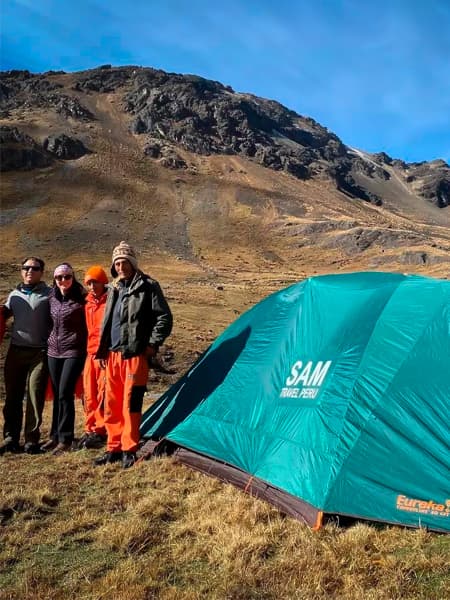
SAM Travel Peru’s porters come from the villages of Yanahuara, Willoq, Ccorao, and the upper reaches of Ollantaytambo. Most porters are males, and many have smallholdings or farms that they tend when not working the Inca Trail. Sam Travel has taken it upon themselves to hire more female porters and integrate them into this male dominated industry.
Our porters are 18-45-years-old, and many have worked with us for years. They speak Quechua, with some younger porters also speaking Spanish, and a few have some English.
A piece of our history
The Owner of SAM Travel, Saul Alvarez started his career as a porter and moved up to being an assistant cook, and then worked as a guide for many years and has now been planning Inca Trail treks for over 10 years. Saul’s experience as a porter and guide has helped him gain an appreciation of what works and does not work well on tours & treks and within the industry. Now as the owner of SAM Travel Peru, he is involved in every aspect of making sure his business runs smoothly, which keeps him on his toes. Despite his impressive workload, he keeps everything in tip top shape and all with a smile on his face.
All our porters get advanced warning of the required numbers so that the villages can decide who to send. We provide transport to and from the trek and pay them the official rate.
We provide tents and mattresses for the porters. Some companies let porters sleep in the dining tent, which have no floor, are draughty, and can let rainwater run across the floor.
Meals include meat, quinoa, lentils, rice and beans, rather than the more international food served to hikers.
Porters are given presents on special celebratory days like Christmas, Pachamama, and Worker’s Day to recognize and appreciate their efforts.
What do the Inca Trail porters carry?
Before we discuss what they carry, we take a brief overview of how many porters we bring on each trek and how the load is evenly distributed. The number of porters will depend on the size of the group. For a group of 2 trekkers, there will have 4 porters, 4 trekkers will have 6 porters, 6 trekkers will have 9 porters, 8 trekkers will have 12 porters. Inca Trail porters carry pretty much everything from tents to food and medical supplies. They also heft people’s belongings, including sleeping bags, mattresses, portable toilet, clothes, and personal items and help set up and break camp daily.
All rubbish is packed up and brought out on the porter’s backs. The porter carrying the toilet tent deserves a special tip. Theirs is the only burden that gets heavier as the trek progresses!
How much weight do Inca Trail porters carry?
Inca Trail porters carry a maximum of 20kg weight with 5kg for their personal belongings (males), and a maximum of 15kg for female porters. Porters cannot exceed 25kg in weight and this rule is strictly enforced.
There are various checkpoints along the Inca Trail, including at the start, to ensure limits are obeyed. Some companies try to get porters to use the 5kg personal allowance for the group’s kit, we would never implement this at all. That’s why we insist that your weight cannot exceed 7kg, including mattress and sleeping bag. The longevity and physical health of all our porters is of the utmost importance to us.
What kind of supplies does Sam Travel provide for its porters
All our porter receive proper equipment. We provide the following items to our porters and cooks for free: Work and life insurance, jacket, sun hat, warm hat, t-shirt, pants, hiking boots, comfortable duffle bags, canteen, girdle for protecting their spine, sleeping bag and mattress. Our female porters are given skirts and dresses to make sure they are comfortable hiking without breaking their cultural traditions.
How much should I tip my Inca Trail porter?
Tipping your Inca Trail porter is a way to show appreciation for their work. Your porter has an arduous trek no matter what happens, the weight remains the same.
We understand tipping is not part of every culture, so we pay our Inca Trail porters well.
However, tipping is part of Peruvian culture to reward a job well done. There are two ways to tip. Firstly, the group can pool all tips and give them to the head guide, who then distributes the pot among all workers. There is a hierarchy that the guy follows when handing out the kitty.
Secondly, you can tip your personal porter individually and directly.
Tipping recommendations
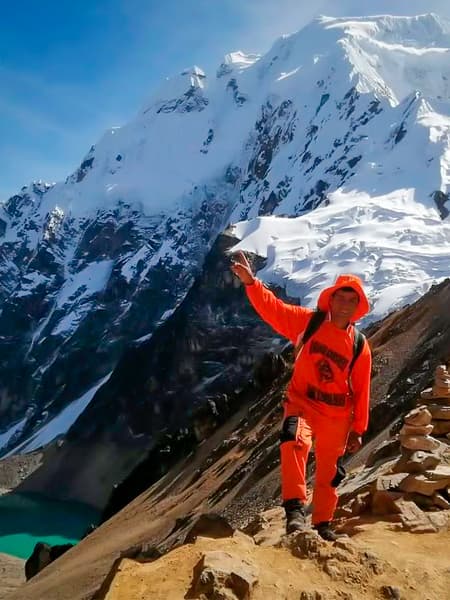
Communal tipping: Allow USD 10-20 per person, per day, so USD 40-80 in total, to cover the guide, cook, and porters on a 4-day trek.
Direct tip to Inca Trail porter: Allow USD 5-7 per person per day, making USD 20-28 per person directly to the porter.
You can tip both directly and communally if you wish. We recommend against giving large individual tips because this can distort the wage structure within the team.
How else can I reward my Inca Trail porter?
Tipping is just one way to show your appreciation for your porter.
Learning a few words in Quechua will earn you immediate respect and warmth from your porters, who are immensely proud of their language and culture. After all, you are on the Inca Trail to learn about Inca culture, which includes the Quechua language.
- Sutinmi (soot-in-me): My name is…
- Inca ñan (In-ka-nee-an): Inca Trail
- Somaq mihuna (so-mak-mee-hoo-na): Amazing food!
- Allianchu (eye-eee-an-choo): Hi, how are you?
- Allianmi (eye-eee-on-mee): I’m fine, thanks.
- Sulpayki (sool-pay-key): Thanks.
- Tupananchikama (two-pan-an-cheese-kama): Goodbye
Ask them about the songs they sing, and don’t be afraid to join in. Share coca leaves if you brought some. Coca leaves are also used in the mountainous regions as offerings and an extension of friendship.
How does SAM Travel ensure responsible trekking on its Inca Trails?
SAM Travel is in constant contact with our Inca Trail team, checking standards and looking for ways to improve. We always include a personal porter to promote local employment and promote tourism socially responsible tourism.
As private contractors, we want our porters to be well fed, dry, warm, and happy so that they not only choose to work with us again, but look forward to it. The Inca Trail is a celebration of their culture, and their efforts, alongside your own efforts.
Inca Trail porters and responsible trekking
The Inca Trail is a bucket list hike and one of Peru’s travel highlights. With its orchids, condors, cloud forest, and snow-capped peaks, this beautiful trail is open to all with training and determination.
SAM Travel Peru wants people to enjoy the Inca Trail, safe in the knowledge that the porters are respected and rewarded for their hard work and efforts. We hope that by understanding their role, language, and tipping, you can thoroughly enjoy your experience and leave nothing but a positive and responsible footprint.
What is the Inca Trail Trek?
The Inca Trail trek to Machu Picchu has been voted one of the new seven wonders of the world, and it’s no surprise why. People travel to Cusco, Peru, with high expectations and are seldom disappointed. You will reach astonishing heights and see unimaginable views. Passing architectural marvels, stunning Andean landscapes, including snow-capped mountains, lush forests, and high-altitude plateaus. Also, embrace the challenge of the steep incline and decline of over 10 000 stairs along the Inca Trail. Obviously this trek would be brutal without the help of the porters. Which is why we regard our porters as the heroes of each and every trek we embark on.
The high-altitude trek snakes through the Vilcabamba mountain range, reaching a high point of 4,222m/13,852ft at Dead Woman’s Pass. Hikers gain 2,153m/7,063ft over the entire trail.
The highest campsite is at an oxygen-light 3,603m/11,821ft, and the lowest point is the Machu Picchu ruins at the hike’s end, sitting at a relatively balmy 2,452m/8,046ft.
Every hiker needs a permit to walk the Inca Trail. These permits are limited to 500 per day and sold on a first-come, first-served basis; the peak May-September season sells out many months in advance.
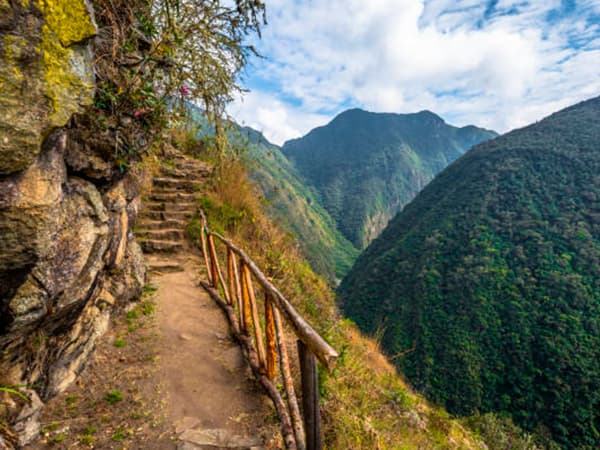
There is a 4-day Inca Trail, and a 5-day Inca Trail that is the same route but hiked more slowly.
Groups are accompanied by official guides and porters that carry the communal weight burden, everything from dining tents to food to chemical toilets. On average, around 20 porters will accompany every 12 strong group. About 300 porters and 200 tourists set off from KM82 daily.
Archeological sites inside the Inca Trail Peru
| Site | Location / Position | Description | Function / Significance |
|---|---|---|---|
| Salapunku | Opposite side of the river after Km 82 | Large walls and a massive gate | Possibly the entrance to Machu Picchu from the Sacred Valley |
| K’anabamba | Opposite side of the river | Secondary archaeological site | Resting place for travelers |
| Llactapata | Along the trail | Complex with multiple buildings, stone construction | Residence of an Inca noble or chieftain |
| Willkarakay | Upper section of Llactapata | Circular structures with strategic views | Religious use by priests |
| Runkurakay | Mid-trail (high elevation) | Semicircular ruins | Rest stop for messengers; religious site (moon-related) |
| Sayakmarka | Overlooking cloud forest valleys | Well-preserved site with narrow passages and terraces | Religious & military control point (Temple of the Sun) |
| Conchamarka | Below Sayakmarka | Terraces with large rectangular buildings | Likely residence of an important figure or priest |
| Phuyupatamarca | High mountain (3,700 m / 12,100 ft) | “City above the clouds” with water features | Religious center tied to water and mountain worship |
| Intipata | Steep mountainside | Extensive agricultural terraces | Farming site adapted to terrain |
| Wiñay Wayna | 6 km from Machu Picchu | Large complex with terraces and ritual spaces | Possibly a tambo (rest stop); gateway to Machu Picchu |
| Intipunku | Final approach to Machu Picchu | Sun Gate aligned with the winter solstice | Main ceremonial entrance to Machu Picchu |
| Machu Picchu | End of the Inca Trail | 15th-century Inca citadel | Royal, religious, and administrative center |